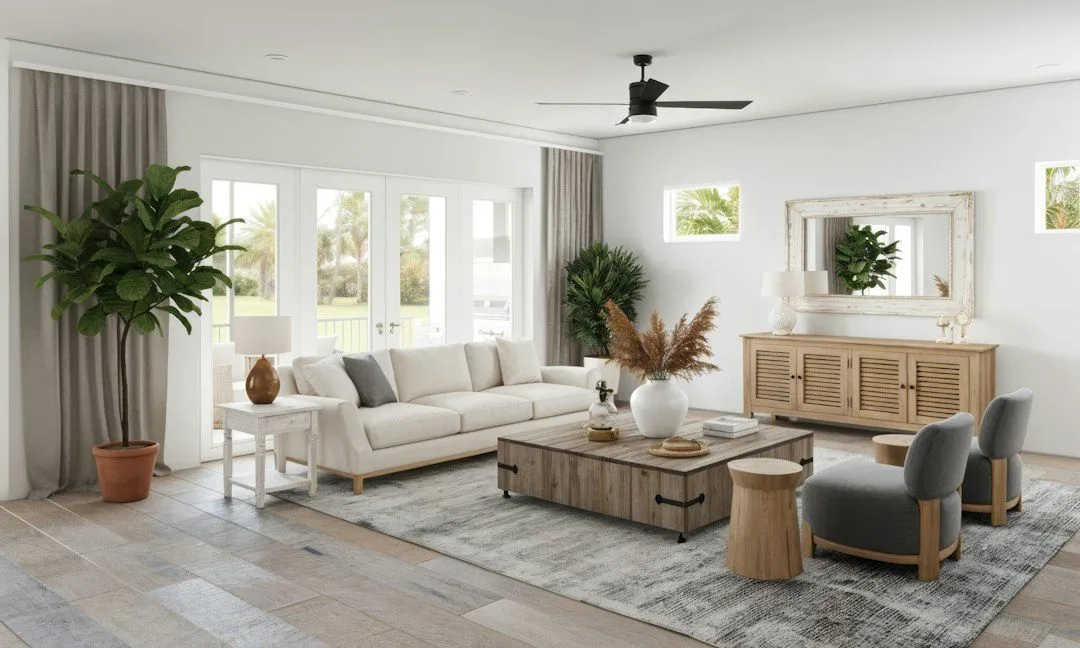
Selecting window treatments is one of the most practical decisions in coastal interior design — and one of the most site-specific. The light near the water is different: brighter, more directional, rich in UV. A treatment that works inland may fail here within a season.
The light problem coastal rooms share
Coastal California sun arrives at low angles in the morning and reaches full intensity by midday. Glass amplifies it. Pale surfaces bounce it. In a well-designed coastal room, the challenge is not blocking this light — it is mediating it. A room sealed against its own views has lost the point entirely.
South- and west-facing rooms take the most direct load. East-facing rooms have it easier — the morning light is warm and low, and by afternoon the intensity has moved on. North-facing rooms in a coastal house are rare but valuable; they hold an even, diffuse quality all day. Understanding which windows carry the problem determines the treatment specification before fabric selection begins.
Linen
The studio’s default fabric for coastal rooms is linen — loosely woven, undyed or in a natural tone. It softens light without absorbing it, adds warmth where hard materials dominate, and moves with sea air in a way heavier fabrics do not. More practically, Belgian and Irish linen hold up to coastal UV better than cotton or synthetic blends, which break down faster and sometimes stiffen in salt humidity.
Colour matters. Raw flax, oat, and warm greige hold their tone longer than bleached white, which can yellow where it receives the most light. The studio typically pulls samples and leaves them in the room’s actual light for at least a week before confirming a specification.
Layering for control
Single panels rarely solve the coastal light problem. The approach is almost always two layers: an inner sheer for midday diffusion, and an outer linen panel for privacy and weight.
During the brightest hours, both close. In the morning and evening, the linen stays open and the sheer alone mediates the quality of light. The room remains functional at every hour without shutting out the view.
For south-facing windows where fading is a genuine concern, a woven solar shade — specified in a tone that reads as trim — can sit inside as a third layer. It blocks UV without blackout. This is the reliable solution for rooms where the sun load is sustained and the furnishings are worth protecting.
Hardware
Simple hardware reads better here than decorative. Unlacquered brass, matte iron, or warm bronze rods suit the material palette of a coastal room without competing with it. Where the window is already complex — deep reveal, low ceiling, detailed surround — a recessed track system is the cleaner option.
The rod should extend far enough beyond the frame that the panel clears the glass entirely when open. One of the most common treatment mistakes is a rod barely wider than the window: panels drawn to either side still cover a quarter of the glass. In a coastal room where the view is the main event, this is worth getting exactly right.
Ceiling-to-floor length reads better than apron length in rooms where ceiling height is part of the composition. A clean hover at the floor — not a puddle, not an inch above — reads as intentional. Panels should be fullness-cut rather than flat: two-and-a-half times the width of the window in most applications.
Privacy and the view
Most coastal clients came for the view. Privacy has to be solved without eliminating it.
The studio reviews sight lines before specifying. A ground-floor room visible from a walkway or neighboring property needs different coverage than an upper floor facing open water. High-hung panels — rod placed at ceiling height, panel stopping at privacy height rather than the floor — can provide coverage without closing a room entirely.
Motorization is useful in spaces where light management matters but drawing a curtain would mean crossing the room several times a day. It suits rooms with difficult-to-reach windows, tall openings, or where the treatment is expected to follow the arc of the sun rather than stay in one position.
Window treatments are part of the same logic that governs everything else in a quiet coastal home: materials that handle the environment honestly, restraint that holds the view, decisions made for actual conditions rather than for a showroom moment.
The studio specifies window treatments as part of full-room design for clients across Newport Beach and the coast. Explore interior design services, or get in touch to discuss a project.