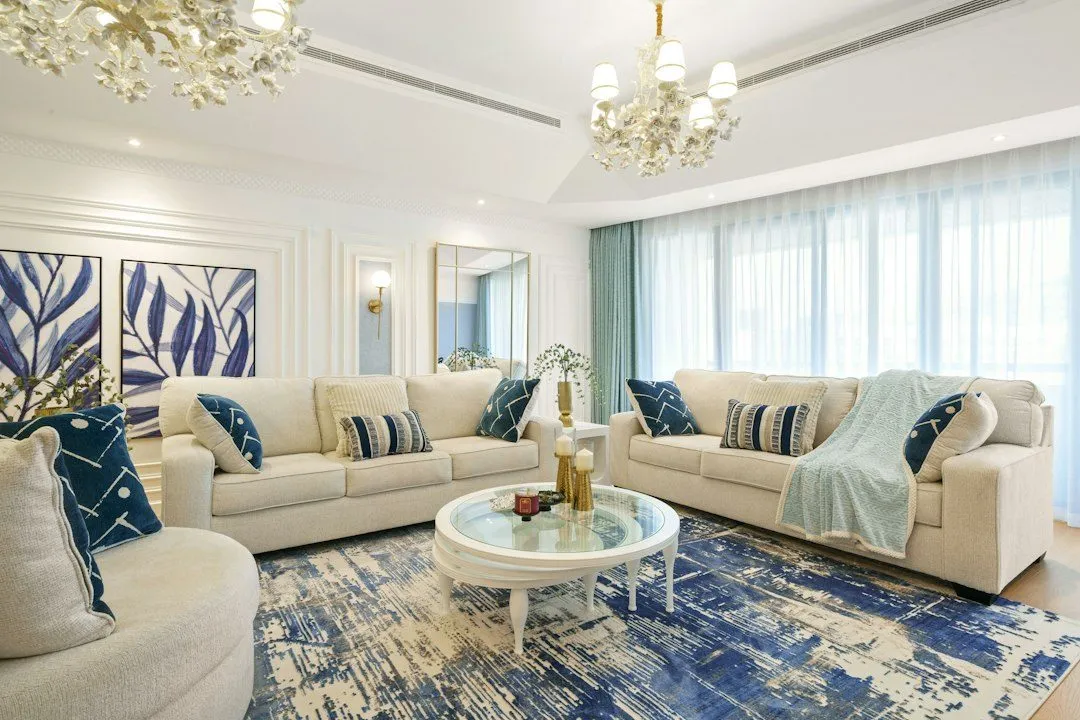
Warm minimalist interior design is not a contradiction. The warmth comes from material; the minimalism comes from discipline. Neither requires sacrificing the other.
Why minimalism reads cold
The version of minimalism that feels cold usually lacks material. White walls with a flat finish, thin-legged furniture, bare stone floors: restrained in form, but stripped of the tactile weight that makes a room feel inhabited. Take that approach into a coastal home, and the brightness of the light amplifies it. The result reads more clinical than calm.
The correction is not to add more things. It is to add better surfaces.
Material is the warmth
The warmest minimal rooms are built around a short list of natural materials chosen for character: a plaster wall with visible hand-work, a rift-sawn timber floor, a stone counter with honest variation. None of these are decorative. They are structural — the room’s atmosphere follows from them.
Linen curtains with weight. A wool rug with visible pile. Natural finishes on hardware. Each surface contributes texture, and texture is what the eye reads as warmth. The palette can remain entirely within a narrow range of warm neutrals — off-white, warm grey, driftwood — and the room still feels alive because the surfaces are alive.
This is the same material-first logic behind the studio’s approach to organic modern interior design: surfaces are selected first, and the furniture follows. Warm minimalism draws from the same discipline, applied to a quieter and more pared-back register.
Light working with surface
Coastal light is strong, directional, and moves through the day. In a minimal room with honest surfaces, that movement becomes part of the composition — morning warmth settling into plaster, afternoon shadows crossing a textured wall, the quality of evening light through linen rather than cotton.
A warm minimal interior treats the light as part of the brief. Pale, hand-finished plaster reflects without glare. Matte floors absorb and distribute. The interplay is the design.
The same principle runs through modern coastal interior design more broadly: let the light lead, and choose materials that age well. Surfaces that age tend to grow warmer as they do. Unlacquered brass develops a patina. Hand-finished plaster deepens. The change is not wear. It is the material finding its character.
Curation, not emptiness
A warm minimal room holds fewer objects than a more traditionally furnished interior. What it holds is chosen with corresponding care. A single ceramic vessel. A well-made basket. One plant, positioned for form. The restraint of the collection is what makes each piece legible.
This editing is what distinguishes a designed room from a styled one. It is not about emptiness — it is about selection. Knowing what earns a place and what competes with the room’s own material quality. That judgment is what takes time to develop, and it is the difference between a room that reads as quiet and one that merely reads as sparse.
How the studio approaches it
In the studio’s work across San Clemente and Orange County, warm minimalism arrives most often when clients describe what they want as “calm but not cold” or “simple but with some life.” They already understand the register. The work is in finding the material vocabulary that delivers it.
Walls in Venetian plaster or tadelakt. Floors in white oak. A neutral linen on windows that filters without blocking the view. Furniture in natural materials with clean lines and proper scale. Hardware in unlacquered brass or forged iron. None of this is novel. The sequence — fixed surfaces first, objects last — is what makes it work.
The result is a room that reads as considered rather than sparse, warm rather than decorated. That is the distinction worth building toward.
Considering the direction for your home? Get in touch.